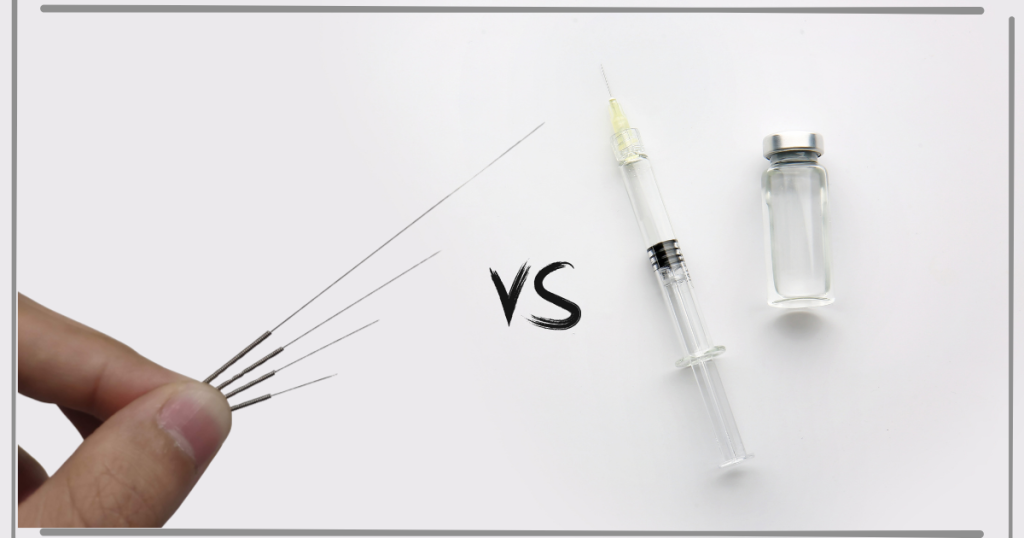
You Don’t Have to Sacrifice Your Vanity for Your Ethics: Why Botox and Cosmetic Acupuncture Can Coexist
There seems to be a strange assumption in the wellness and natural health space that if you choose acupuncture, Traditional Chinese Medicine or a more holistic approach, you somehow need to reject everything else.
And I don’t agree.
You can care deeply about your health, your ethics and your wellbeing and still care about how you look.
You can want to soften a frown line.
You can enjoy having Botox.
You can love your skincare routine.
You can be interested in cosmetic acupuncture.
And you can do all of those things while still taking a thoughtful, whole-person approach to your health.
At Sheng Works, we have many patients who use both it’s not a case of Botox vs Cosmetic Acupuncture.
And that’s completely okay.
Beauty Doesn’t Have to Be an Either-Or Decision
Let’s take the judgement out of the conversation. There is nothing inherently contradictory about caring about your health while also caring about your appearance. We all make choices about how we want to look and feel.
Some people enjoy skincare.
Some enjoy exercise.
Some choose cosmetic treatments.
Some don’t.
None of these choices automatically tells us how someone feels about their health, their ethics or their values.
The important thing is understanding what you’re choosing, why you’re choosing it, and making informed decisions about how those choices fit together.
That’s particularly relevant when we’re talking about Botox and Constitutional Cosmetic Acupuncture.
They aren’t competing treatments.
They simply work in very different ways.
Botox Explained
Botox is a brand name for a prescription medicine containing botulinum toxin type A. In simple terms, it works by temporarily reducing the ability of specific muscles to contract. When injected into selected facial muscles, this reduction in muscle movement can soften the appearance of dynamic facial lines — the lines that develop or become more noticeable when we make facial expressions, such as frown lines, forehead lines and crow’s feet. The effect isn’t permanent. Over time, normal muscle activity gradually returns and the cosmetic effect wears off. Botulinum toxin is a medical treatment, so it needs to be administered by an appropriately qualified practitioner who can assess whether it’s suitable for you, explain the potential benefits and risks, and provide appropriate aftercare.
And this is where we think the conversation gets interesting. Botox and Constitutional Cosmetic Acupuncture don’t have to be competing treatments.
One doesn’t need to be rejected for the other to have a place.
Your Face Is Part of Your Whole Body
Constitutional Cosmetic Acupuncture works from a completely different philosophy. We’re not injecting a substance into a muscle to temporarily reduce its movement. We’re using acupuncture within a Traditional Chinese Medicine framework and looking at you as a whole person.
We consider Your whole health.Your sleep. Your stress. Your energy. Your digestion. Your emotional wellbeing. Your constitution. Your facial tension.
And yes, the appearance of your skin and face.
The goal isn’t to tell you that one approach is morally superior to another. The goal is to understand what each approach does — and make informed decisions about how they might fit into your life.
What Is Constitutional Cosmetic Acupuncture?
Constitutional Cosmetic Acupuncture combines facial acupuncture techniques with acupuncture based on Traditional Chinese Medicine principles. Your treatment isn’t determined solely by what you see when you look in the mirror. We also consider the broader picture of your health and wellbeing. That may include:
- Sleep
- Stress
- Energy
- Digestion
- Emotional wellbeing
- Lifestyle
- Facial and jaw tension
- Your individual TCM presentation
This is what makes the treatment constitutional. We’re not simply treating a face. We’re treating a person who happens to have a face.
What the Research Actually Tells Us
Research into facial cosmetic acupuncture is still developing. A study investigating facial cosmetic acupuncture reported improvements in measures of facial elasticity following treatment. However, the researchers were clear that larger group studies are needed before firm conclusions can be drawn.
That’s an important distinction. There is a difference between saying “research is promising” and saying “this treatment definitely produces a particular cosmetic result.”
At Sheng Works, we prefer the first approach.
We want to be excited about emerging research without overstating what the evidence can currently tell us. The same principle applies to Botox. There is substantial clinical research supporting its use for certain cosmetic indications, but it is still a medical treatment with benefits, limitations and potential adverse effects.
Understanding both treatments means you can make decisions based on information rather than marketing.
So What Happens If You Use Both?
This is something we see regularly in clinic. And the answer is simple:
We work around each other.
If you’ve recently had Botox, we ask where you’ve been treated and when.
As a precaution, we avoid needling directly into the treated area for two weeks following your Botox treatment.
This allows us to work strategically around your recent cosmetic treatment rather than unnecessarily needling or manipulating the area.
Once that period has passed, we can reassess your treatment plan and continue your acupuncture care appropriately.
We’re not suggesting that acupuncture “cancels out” Botox.
We’re not suggesting that one treatment makes the other unnecessary.
We’re simply recognising that your healthcare and cosmetic choices can coexist — and adjusting our treatment accordingly.
You Don’t Have to Choose Between Vanity and Values
I actually think there’s something quite empowering about taking the judgement out of beauty treatments. You don’t need to defend wanting to look good. You also don’t need to abandon your values to do it. You can make informed choices. You can understand what you’re having done. You can choose treatments based on what matters to you. And you can work with practitioners who understand the other treatments you’re having rather than expecting you to fit neatly into one particular philosophy. That’s what we mean when we talk about integrative care.
It’s not about throwing every treatment available at you. It’s about choosing the right tools for the right person at the right time.
Less Running Around. More Strategic Care.
This is one of the practical benefits our patients often appreciate.
You don’t necessarily need to have completely separate worlds for your cosmetic and wellbeing treatments.
With some planning, your acupuncture appointments can be strategically scheduled around your other treatments.
For example, if you regularly have Botox every few months, we can work with that schedule.
You might have your Botox treatment with your cosmetic practitioner and then plan your acupuncture appointments around it, with the appropriate two-week precaution around the treated area.
That means your treatment plan can be intentional rather than reactive.
Fewer unnecessary appointments.
Less running around.
Less time trying to coordinate everything.And potentially less money spent simply because you’ve been treating every concern as a completely separate problem.
The beauty of this strategy — pardon the pun — is that we don’t have to be mutually exclusive services.
The Whole Patient Is Still the Patient
This is the part that matters most to us. We don’t want to treat you as a forehead.
Or a frown line.
Or a set of crow’s feet.
You’re a whole person.
And your health, wellbeing and appearance all exist within that same body.
If Botox is part of your personal approach to how you want to look and feel, that’s okay.
If Constitutional Cosmetic Acupuncture is part of it too, that’s okay.
Our role isn’t to judge those choices. Our role is to understand them, work safely around them, and continue supporting the whole patient — not just their fine lines. You don’t have to sacrifice your vanity for your ethics. And you don’t have to sacrifice your wellbeing for your appearance. You can make informed choices about both. If you’d like to explore how Constitutional Cosmetic Acupuncture could fit alongside your existing cosmetic treatments, talk to us about your current treatment plan before your appointment.
Let’s make the different pieces work together.
Research & Further Reading
Small R. Botulinum Toxin Procedures: A Practical Approach to Cosmetic Injections. American Family Physician. 2026;113:449–456. This recent review explains how botulinum toxin works, its common cosmetic applications, expected duration and potential adverse effects. https://pubmed.ncbi.nlm.nih.gov/42202343
Gostimir M, Liou V, Yoon MK. Safety of Botulinum Toxin A Injections for Facial Rejuvenation: A Meta-Analysis of 9,669 Patients. Ophthalmic Plastic & Reconstructive Surgery. 2023;39(1):13–25. https://pubmed.ncbi.nlm.nih.gov/35353777
Carruthers J, et al. Consensus Recommendations for Combined Aesthetic Interventions in the Face Using Botulinum Toxin, Fillers, and Energy-Based Devices. Dermatologic Surgery. 2016;42(5):586–597. https://pubmed.ncbi.nlm.nih.gov/27100962
Yun Y, et al. Effect of Facial Cosmetic Acupuncture on Facial Elasticity: An Open-Label, Single-Arm Pilot Study. Evidence-Based Complementary and Alternative Medicine. 2013. https://pubmed.ncbi.nlm.nih.gov/23983778
Note: Research into cosmetic acupuncture remains limited, and individual results vary. Cosmetic acupuncture should not be presented as equivalent to, or a replacement for, botulinum toxin treatment. Likewise, botulinum toxin is a medical treatment with its own indications, limitations and potential adverse effects.
Written by Cosmetic Acupuncturist Mandy Gratzer
 All our practitioners are Ahrpa registered Acupuncturists